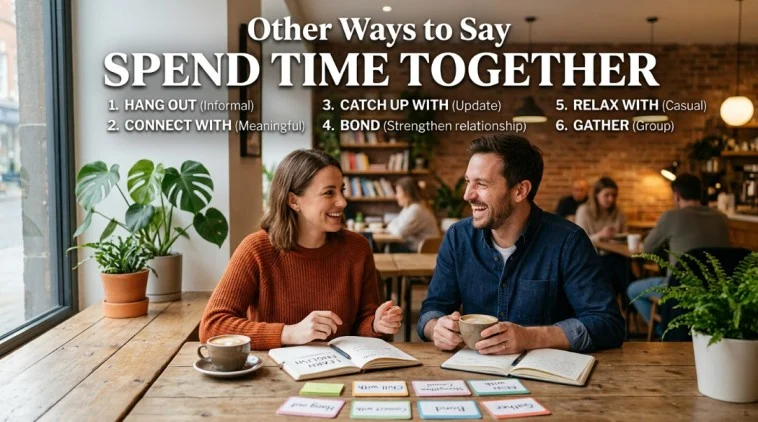
Quick Answer:
If you want to replace spend time together, you can choose a phrase based on your relationship, setting, and level of formality. Top alternatives include enjoy time together, socialize, meet up, connect, share time together.
The phrase spend time together describes being with another person or group and sharing time through conversation, activities, meals, travel, or simple companionship. It is one of the most natural expressions in everyday English, making it useful in conversations, messages, invitations, and personal writing.
Learning alternatives to spend time together can help you communicate with greater precision. You might want to sound warmer when talking with friends, more polished in a professional setting, or more expressive when describing a meaningful relationship. Choosing the right phrase can make a sentence feel more natural and intentional.
For English learners, knowing other ways to say spend time together is also useful for avoiding repetition and expanding vocabulary. These expressions can help you express excitement in English, describe social plans clearly, and adapt your language to different audiences and situations.
Formal Alternatives to “Spend Time Together”
Enjoy Each Other’s Company
This phrase emphasizes pleasure and companionship.
Example: We enjoyed each other’s company during the evening.
Share Meaningful Time
This expression highlights the value or significance of the time spent together.
Example: The family shared meaningful time during the holiday.
Spend Quality Time Together
This phrase suggests that the time was valuable, focused, or emotionally important.
Example: We made an effort to spend quality time together.
Maintain Personal Connections
This is more formal and focuses on preserving relationships.
Example: Regular meetings help us maintain personal connections.
Pro Tip: Use formal alternatives when writing about relationships in professional, academic, or carefully worded personal contexts.
“The best alternative is the one that matches the relationship, setting, and purpose.”
Casual Alternatives
Hang Out Together
A common conversational expression for relaxing or socializing.
Example: We usually hang out together after work.
Get Together
A natural phrase for meeting socially.
Example: Let’s get together this weekend.
Meet Up
This usually refers to arranging a meeting.
Example: We can meet up for coffee tomorrow.
Enjoy Time Together
A friendly and broadly useful alternative.
Example: We always enjoy time together when we visit.
Pro Tip: Casual phrases work best in friendly conversations, texts, social media, and informal invitations.
Professional Alternatives
Connect With One Another
This emphasizes communication or relationship building.
Example: The team had an opportunity to connect with one another.
Build Relationships
This focuses on developing stronger personal or professional connections.
Example: Team events help employees build relationships.
Collaborate Together
This is appropriate when the shared time involves working toward a goal, although collaborate alone is usually more natural.
Example: We collaborated on the project throughout the week.
Network With Colleagues
This specifically refers to professional relationship building.
Example: The conference gave us time to network with colleagues.
Pro Tip: In workplace writing, choose a phrase that explains the purpose of the interaction instead of simply saying you spent time together.
Informal Expressions
Catch Up
Used when people meet to discuss what has happened in their lives.
Example: We should catch up over coffee soon.
Socialize
A general term for interacting socially.
Example: Employees can socialize during the company event.
Get Some Time Together
A relaxed way to emphasize finding available time.
Example: We finally got some time together after a busy month.
Enjoy Some Company
This focuses on having someone around and enjoying their presence.
Example: I stayed because I wanted to enjoy some company.
Pro Tip: Informal expressions are ideal for conversations with friends and familiar people, but they may sound too relaxed in formal business writing.
Common Mistakes When Using “Spend Time Together”
1. Using “Spend Time” Without the Correct Object
Incorrect: We spend together every weekend.
Correct: We spend time together every weekend.
2. Confusing “Spend Time” With “Save Time”
Incorrect: We saved time together at the park.
Correct: We spent time together at the park.
3. Using the Phrase for Every Context
Incorrect: Our executives spent time together to negotiate the contract.
Better: Our executives met to discuss the contract.
4. Repeating the Same Phrase Too Often
Incorrect: We spend time together at lunch, spend time together after work, and spend time together on weekends.
Better: We have lunch together, meet after work, and catch up on weekends.
5. Choosing an Expression That Does Not Match the Relationship
Incorrect: I networked with my sister during the holiday.
Better: I enjoyed time with my sister during the holiday.
“Vocabulary becomes more powerful when you choose words for the situation, not just the dictionary meaning.”
What Does “Spend Time Together” Mean?
Spend time together means being with another person or group for a period of time, usually for companionship, conversation, activities, relaxation, or shared experiences.
Grammatically, spend is a verb followed by time, while together indicates that two or more people are sharing the experience.
Example: We spent time together after dinner.
The expression is grammatically correct, natural, and extremely common in everyday English.
When to Use “Spend Time Together”
You can use spend time together in many situations, including:
- Talking about family activities
- Describing time with friends
- Discussing romantic relationships
- Talking about holidays and vacations
- Describing social gatherings
- Writing personal messages
- Talking about quality time
- Discussing relationship building
- Describing team activities
- Making informal plans
Spoken English
The phrase sounds natural in everyday conversation.
Example: We should spend some time together soon.
Written English
It also works well in emails, personal writing, articles, and general communication.
Example: The program encourages families to spend time together.
Formal English
The expression is grammatically acceptable but may be replaced by more precise wording in highly formal contexts.
Informal English
It is completely natural in texts, conversations, invitations, and messages between familiar people.
Is It Professional or Polite to Say “Spend Time Together”?
Polite? ✔️ Yes
Professional? ❌ No, in most cases
The phrase itself is not rude or inappropriate. However, it can sound too personal or vague in professional communication. Workplace writing often benefits from a more specific expression such as meet, collaborate, connect, discuss, or network.
Business-style example:
Instead of saying, “We spent time together discussing the project,” write, “We met to discuss the project and review the next steps.”
Pros and Cons of Using “Spend Time Together”
Pros
- Simple and natural: Easy for most English speakers to understand.
- Friendly tone: Works well when discussing relationships.
- Common usage: Frequently used in spoken and written English.
- Easy to understand: Suitable for English learners and general audiences.
Cons
- Too informal for work: It can sound vague in professional contexts.
- Overused: Repeating it can make writing feel predictable.
- Limited emotional range: It does not always communicate the exact nature of the connection.
- Not suitable for formal writing: More precise vocabulary may be preferable.
Other Ways to Say “Spend Time Together” With Examples
These alternatives will help you sound more fluent, confident, and natural in different situations.
Use them according to tone, context, and audience to express excitement, admiration, or approval.
1. Phrase: Enjoy Each Other’s Company
- Meaning: Enjoy being together with another person.
- Explanation: It emphasizes pleasure in someone’s presence.
- Example Sentence: We really enjoyed each other’s company during the trip.
- Best Use: Personal relationships
- Worst Use: Formal reports
- Tone: Warm, polished, friendly
- Context Variability: Casual: “We enjoyed each other’s company.” Professional: “The guests enjoyed each other’s company.” Spoken: “We really enjoyed each other’s company.”
2. Phrase: Spend Quality Time Together
- Meaning: Spend valuable or meaningful time with someone.
- Explanation: It suggests focused and worthwhile companionship.
- Example Sentence: We try to spend quality time together every Sunday.
- Best Use: Family relationships
- Worst Use: Technical writing
- Tone: Warm, sincere, positive
- Context Variability: Casual: “Let’s spend quality time together.” Professional: “The initiative promotes quality time together.” Spoken: “We need more quality time together.”
3. Phrase: Get Together
- Meaning: Meet socially with another person or group.
- Explanation: It is one of the most flexible informal alternatives.
- Example Sentence: Let’s get together after work.
- Best Use: Social plans
- Worst Use: Formal reports
- Tone: Casual, friendly, natural
- Context Variability: Casual: “Let’s get together.” Professional: “The teams will get together for a review.” Spoken: “When can we get together?”
4. Phrase: Hang Out Together
- Meaning: Relax and spend casual time with someone.
- Explanation: It is commonly used in relaxed conversation.
- Example Sentence: We like to hang out together on weekends.
- Best Use: Close friends
- Worst Use: Business emails
- Tone: Relaxed, casual, friendly
- Context Variability: Casual: “We hung out together.” Professional: Usually avoid. Spoken: “Want to hang out together tonight?”
5. Phrase: Meet Up
- Meaning: Arrange to meet someone.
- Explanation: It focuses more on the meeting than the entire shared experience.
- Example Sentence: We can meet up for lunch tomorrow.
- Best Use: Social arrangements
- Worst Use: Academic papers
- Tone: Casual, natural, conversational
- Context Variability: Casual: “Let’s meet up.” Professional: “We can meet up before the event.” Spoken: “Where should we meet up?”
6. Phrase: Catch Up
- Meaning: Meet or talk after some time apart.
- Explanation: It often involves discussing recent experiences or news.
- Example Sentence: We met for coffee to catch up.
- Best Use: Friends, colleagues
- Worst Use: Formal documents
- Tone: Friendly, conversational, relaxed
- Context Variability: Casual: “Let’s catch up.” Professional: “I’d like to catch up regarding the project.” Spoken: “We should catch up soon.”
7. Phrase: Socialize
- Meaning: Interact with other people socially.
- Explanation: It describes general social interaction rather than a specific relationship.
- Example Sentence: The employees had time to socialize after the meeting.
- Best Use: Social events
- Worst Use: Romantic messages
- Tone: Neutral, social, professional
- Context Variability: Casual: “We socialize regularly.” Professional: “Employees can socialize at the event.” Spoken: “We stayed to socialize.”
8. Phrase: Connect
- Meaning: Build or strengthen a personal or professional relationship.
- Explanation: It emphasizes meaningful interaction rather than simply being present.
- Example Sentence: The retreat gave everyone a chance to connect.
- Best Use: Relationship building
- Worst Use: Exact scheduling
- Tone: Modern, positive, professional
- Context Variability: Casual: “It was great to connect.” Professional: “The event helped us connect.” Spoken: “Let’s connect sometime.”
9. Phrase: Connect With One Another
- Meaning: Interact and develop a stronger relationship.
- Explanation: It is useful when the relationship itself matters.
- Example Sentence: The workshop gave participants time to connect with one another.
- Best Use: Group settings
- Worst Use: Simple invitations
- Tone: Professional, warm, positive
- Context Variability: Casual: “We connected with one another.” Professional: “Teams connected with one another.” Spoken: “It was nice connecting with everyone.”
10. Phrase: Build Relationships
- Meaning: Develop stronger connections with people.
- Explanation: It focuses on long-term relationship development.
- Example Sentence: Regular meetings help colleagues build relationships.
- Best Use: Workplace settings
- Worst Use: Brief encounters
- Tone: Professional, purposeful, positive
- Context Variability: Casual: “We built a strong relationship.” Professional: “The event helps build relationships.” Spoken: “It’s important to build relationships.”
11. Phrase: Strengthen Our Bond
- Meaning: Make a personal relationship stronger.
- Explanation: It highlights emotional closeness.
- Example Sentence: The trip helped us strengthen our bond.
- Best Use: Close relationships
- Worst Use: Business negotiations
- Tone: Emotional, warm, sincere
- Context Variability: Casual: “It strengthened our bond.” Professional: Usually avoid. Spoken: “The experience strengthened our bond.”
12. Phrase: Share Some Time Together
- Meaning: Spend a period of time in one another’s company.
- Explanation: It provides a softer alternative to the original expression.
- Example Sentence: We should share some time together before you leave.
- Best Use: Personal messages
- Worst Use: Business reports
- Tone: Warm, gentle, personal
- Context Variability: Casual: “Let’s share some time together.” Professional: Limited use. Spoken: “I’d love to share some time together.”
13. Phrase: Enjoy Time Together
- Meaning: Have a pleasant experience while being together.
- Explanation: It adds a positive emotional element.
- Example Sentence: We always enjoy time together during the holidays.
- Best Use: Family, friends
- Worst Use: Formal analysis
- Tone: Positive, warm, natural
- Context Variability: Casual: “We enjoy time together.” Professional: “Participants enjoyed time together.” Spoken: “We always enjoy time together.”
14. Phrase: Have Some Time Together
- Meaning: Have an opportunity to be together.
- Explanation: It sounds natural when emphasizing available time.
- Example Sentence: We finally had some time together after a busy week.
- Best Use: Personal situations
- Worst Use: Formal proposals
- Tone: Simple, natural, warm
- Context Variability: Casual: “We had some time together.” Professional: “The team had some time together.” Spoken: “It was nice having some time together.”
15. Phrase: Make Time for Each Other
- Meaning: Deliberately create time for another person.
- Explanation: It suggests that the relationship is important enough to prioritize.
- Example Sentence: Even when we are busy, we make time for each other.
- Best Use: Close relationships
- Worst Use: Routine meetings
- Tone: Caring, sincere, personal
- Context Variability: Casual: “We make time for each other.” Professional: Limited use. Spoken: “We should make time for each other.”
16. Phrase: Be in Each Other’s Company
- Meaning: Be together or near each other.
- Explanation: It is a polished way to describe shared presence.
- Example Sentence: We were happy to be in each other’s company again.
- Best Use: Formal personal writing
- Worst Use: Casual texting
- Tone: Polished, formal, warm
- Context Variability: Casual: Slightly formal. Professional: “Guests were in each other’s company.” Spoken: “It was pleasant being in your company.”
17. Phrase: Enjoy One Another’s Presence
- Meaning: Take pleasure in being with someone.
- Explanation: It emphasizes appreciation of another person’s presence.
- Example Sentence: The families enjoyed one another’s presence during dinner.
- Best Use: Formal occasions
- Worst Use: Casual texts
- Tone: Elegant, warm, formal
- Context Variability: Casual: Formal sounding. Professional: “Participants enjoyed one another’s presence.” Spoken: “We enjoyed one another’s presence.”
18. Phrase: Reconnect
- Meaning: Restore or renew a relationship after time apart.
- Explanation: It is particularly useful for people who have not met recently.
- Example Sentence: The reunion gave us a chance to reconnect.
- Best Use: Old relationships
- Worst Use: First meetings
- Tone: Warm, reflective, natural
- Context Variability: Casual: “Let’s reconnect.” Professional: “The meeting helped us reconnect.” Spoken: “It was great to reconnect.”
19. Phrase: Spend Some Leisure Time Together
- Meaning: Share free time for relaxation.
- Explanation: It emphasizes relaxation rather than work or obligation.
- Example Sentence: We spent some leisure time together after the conference.
- Best Use: Relaxed activities
- Worst Use: Urgent meetings
- Tone: Formal, relaxed, descriptive
- Context Variability: Casual: Slightly formal. Professional: Suitable in reports. Spoken: “We had some leisure time together.”
20. Phrase: Share an Experience
- Meaning: Experience something together.
- Explanation: It shifts attention from time itself to the activity or event.
- Example Sentence: We shared an unforgettable experience during the trip.
- Best Use: Memorable events
- Worst Use: Routine meetings
- Tone: Reflective, positive, polished
- Context Variability: Casual: “We shared an amazing experience.” Professional: “The teams shared the experience.” Spoken: “We shared a great experience.”
21. Phrase: Enjoy a Shared Experience
- Meaning: Have a positive experience together.
- Explanation: It emphasizes the collective nature of an activity.
- Example Sentence: The event allowed everyone to enjoy a shared experience.
- Best Use: Group activities
- Worst Use: Brief conversations
- Tone: Polished, positive, formal
- Context Variability: Casual: “It was a shared experience.” Professional: “The event created a shared experience.” Spoken: “Everyone enjoyed the shared experience.”
22. Phrase: Come Together
- Meaning: Gather or unite for a common purpose or occasion.
- Explanation: It often describes groups rather than two individuals.
- Example Sentence: Our families came together to celebrate the occasion.
- Best Use: Group occasions
- Worst Use: Private meetings
- Tone: Warm, communal, positive
- Context Variability: Casual: “Everyone came together.” Professional: “The teams came together.” Spoken: “It was great to come together.”
23. Phrase: Gather Together
- Meaning: Meet as a group in one place.
- Explanation: It focuses on physical gathering and shared presence.
- Example Sentence: Friends gathered together for dinner.
- Best Use: Group events
- Worst Use: One-on-one plans
- Tone: Neutral, social, friendly
- Context Variability: Casual: “We gathered together.” Professional: “The committee gathered together.” Spoken: “Everyone gathered together.”
24. Phrase: Meet for Some Quality Time
- Meaning: Meet specifically to enjoy meaningful time together.
- Explanation: It combines the idea of meeting with purposeful companionship.
- Example Sentence: We met for some quality time before the holiday ended.
- Best Use: Personal plans
- Worst Use: Formal meetings
- Tone: Warm, casual, positive
- Context Variability: Casual: Highly natural. Professional: Limited use. Spoken: “Let’s meet for some quality time.”
25. Phrase: Share a Moment
- Meaning: Experience a particular moment together.
- Explanation: It is useful for meaningful or memorable situations.
- Example Sentence: We shared a quiet moment before the ceremony.
- Best Use: Meaningful moments
- Worst Use: Long activities
- Tone: Emotional, gentle, reflective
- Context Variability: Casual: “We shared a moment.” Professional: “The participants shared a moment of reflection.” Spoken: “We shared a special moment.”
26. Phrase: Have Company
- Meaning: Have someone present with you.
- Explanation: It focuses on the pleasant presence of another person.
- Example Sentence: I stayed because I enjoyed having your company.
- Best Use: Personal situations
- Worst Use: Formal scheduling
- Tone: Warm, simple, friendly
- Context Variability: Casual: “I enjoyed your company.” Professional: “Thank you for your company.” Spoken: “It’s nice having your company.”
27. Phrase: Spend Time in Each Other’s Company
- Meaning: Be together for a period of time.
- Explanation: It is a more polished version of the original phrase.
- Example Sentence: We enjoyed spending time in each other’s company.
- Best Use: Polished writing
- Worst Use: Quick texts
- Tone: Formal, warm, elegant
- Context Variability: Casual: More formal. Professional: Appropriate in selected contexts. Spoken: Polished but natural.
28. Phrase: Interact With One Another
- Meaning: Communicate or engage with each other.
- Explanation: It focuses on interaction rather than emotional closeness.
- Example Sentence: The participants interacted with one another throughout the workshop.
- Best Use: Professional settings
- Worst Use: Romantic relationships
- Tone: Neutral, professional, objective
- Context Variability: Casual: Somewhat formal. Professional: Very suitable. Spoken: “The groups interacted well.”
29. Phrase: Network With Others
- Meaning: Meet people to develop professional relationships.
- Explanation: It specifically applies to professional social interaction.
- Example Sentence: The conference gave attendees time to network with others.
- Best Use: Business events
- Worst Use: Family gatherings
- Tone: Professional, purposeful, formal
- Context Variability: Casual: Less common. Professional: Excellent fit. Spoken: “I spent the evening networking.”
30. Phrase: Collaborate With Each Other
- Meaning: Work jointly toward a shared objective.
- Explanation: It is best when the shared time involves productive teamwork.
- Example Sentence: The two departments collaborated with each other to complete the project.
- Best Use: Team projects
- Worst Use: Social gatherings
- Tone: Professional, productive, formal
- Context Variability: Casual: “We worked together.” Professional: “The teams collaborated.” Spoken: “We collaborated on the project.”
“Fluent English is not about using the biggest word. It is about choosing the most accurate phrase.”
Mini Quiz and Self-Check
Question 1
You want to invite a close friend for a relaxed afternoon. Which phrase sounds most natural?
A. Network with one another
B. Hang out together
C. Collaborate with each other
D. Interact with one another
Answer: B. Hang out together
Question 2
Which phrase is most appropriate for a business networking event?
A. Hang out
B. Catch up
C. Network with others
D. Share a moment
Answer: C. Network with others
Question 3
You have not seen an old friend for several years. Which expression fits best?
A. Reconnect
B. Collaborate
C. Socialize
D. Gather together
Answer: A. Reconnect
Question 4
Which sentence sounds most professional?
A. We hung out together to discuss the project.
B. We met to discuss the project.
C. We spent quality time together to discuss the project.
D. We had company to discuss the project.
Answer: B. We met to discuss the project.
Comparison Table: Top Alternatives
| Phrase | Tone | Best Use |
|---|---|---|
| Enjoy each other’s company | Warm, polished | Personal relationships |
| Spend quality time together | Warm, sincere | Family and relationships |
| Get together | Casual, natural | Social plans |
| Meet up | Casual, conversational | Arrangements |
| Catch up | Friendly, relaxed | Friends and colleagues |
| Connect | Positive, professional | Relationship building |
| Socialize | Neutral, professional | Social events |
| Build relationships | Professional, purposeful | Workplace |
| Reconnect | Warm, reflective | Old relationships |
| Network with others | Professional, formal | Business events |
See Also
For more vocabulary expansion, explore another Other Ways to Say guide focused on replacing common everyday expressions.
You can also improve workplace communication with a Professional English guide covering polished phrases for emails, meetings, and conversations.
FAQs
What are the best alternatives to “spend time together”?
Some of the most useful options are get together, meet up, catch up, enjoy each other’s company, connect, socialize, and spend quality time together.
What is a professional way to say “spend time together”?
Depending on the context, use meet, connect, collaborate, build relationships, interact, or network with colleagues.
What is a casual way to say “spend time together”?
Common informal expressions in English include hang out, get together, meet up, and catch up.
How can I avoid repeating “spend time together”?
Choose a phrase based on the actual activity. Use catch up for conversation, network for professional relationships, collaborate for teamwork, and reconnect after time apart.
Can “spend time together” be used in professional English?
Yes, but it can sound vague. In professional communication, a more specific phrase such as meet, connect, collaborate, or network is usually clearer.
Conclusion
Learning other ways to say spend time together gives you more control over tone, meaning, and context. Instead of relying on one familiar expression, you can choose language that communicates friendship, emotional closeness, teamwork, networking, or casual socializing more precisely.
Practice these alternatives in everyday conversations, emails, and writing exercises. Pay attention to who you are speaking to and why you are communicating. Strong English vocabulary is not simply about knowing more expressions; it is about knowing when each expression sounds natural and appropriate.
Discover More Post:

2 thoughts on “30+ Other Ways to Say Spend Time Together | Natural English Phrases, Expert Tips & Real-Life Examples for 2026”