Quick Answer:
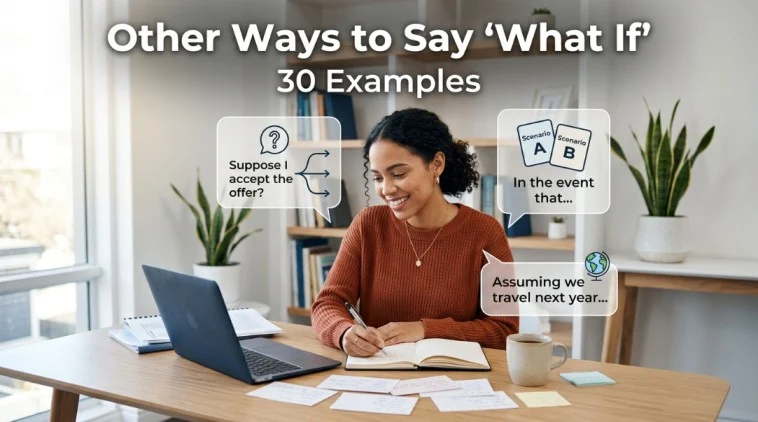
The phrase other ways to say what if includes expressions used to introduce a possible situation, concern, question, or alternative outcome. Useful alternatives include suppose, imagine if, what happens if, assuming that, and consider the possibility that.
Learning other ways to say what if can make your English more flexible when you want to discuss possibilities, raise concerns, or imagine different outcomes. “What if” is one of the most common expressions in English for talking about situations that may happen, might happen, or could happen. You can hear it in everyday conversations, workplace discussions, planning sessions, and hypothetical questions.
Knowing alternatives to other ways to say what if is especially useful for English learners who want to communicate with greater precision. For example, “suppose” sounds natural and conversational, while “consider the possibility that” is more formal and suitable for professional or academic communication. The best expression depends on your audience and purpose.
Building a flexible vocabulary also helps you express excitement in English, ask thoughtful questions, discuss risks, and present hypothetical ideas without repeating the same phrase. Understanding tone is just as important as understanding meaning.
Formal Alternatives to “What If”
For academic writing, formal discussions, reports, and serious communication, consider these expressions:
- Suppose that
- Assuming that
- Consider the possibility that
- In the event that
Pro Tip
Use formal alternatives when presenting hypothetical situations objectively. “In the event that” works particularly well in policies, procedures, and formal workplace writing.
Casual Alternatives
For everyday conversations, these options sound natural:
- Suppose
- Imagine if
- What happens if
- How about if
Pro Tip
“Suppose” and “imagine if” are especially natural when discussing possibilities with friends, classmates, or colleagues in relaxed conversations.
Professional Alternatives
In workplace communication, these expressions can make hypothetical questions clearer:
- What would happen if
- Assuming that
- If this were to happen
- Consider the possibility that
Pro Tip
In professional settings, choose wording that makes the hypothetical situation clear without sounding overly dramatic or uncertain.
Informal Expressions
For relaxed spoken English, you can use:
- Suppose this happens
- Imagine this
- Say that happens
- What happens when
Pro Tip
Informal expressions in English are useful in spontaneous conversations, but more precise wording may be better for formal emails, reports, and presentations.
A hypothetical question can sound curious, cautious, professional, or serious depending on the words surrounding it.
Common Mistakes
1. Using “what if” when asking about a routine situation
“What if” usually introduces a possibility or hypothetical concern.
Example: “What if I go to work every Monday?” can sound unusual if you simply mean to ask about a routine.
Better: “What happens if I go to work every Monday?”
2. Using “suppose” incorrectly with a question structure
Learners sometimes combine structures unnecessarily.
Incorrect: “Suppose if the client refuses?”
Better: “Suppose the client refuses.”
3. Confusing “if” with “what if”
“What if” often expresses concern, curiosity, or a hypothetical possibility.
Example: “What if the meeting is canceled?”
4. Using highly formal expressions in casual conversation
“Consider the possibility that” may sound unnatural when speaking casually with a friend.
Example: Instead of “Consider the possibility that we arrive late,” say, “What if we arrive late?”
5. Forgetting the difference between possibility and certainty
“What if” does not necessarily mean that something will happen.
Example: “What if the train is delayed?” asks about a possible situation rather than stating that the train will be delayed.
What Does “What If” Mean?
“What if” is an expression used to introduce a possible, hypothetical, or imagined situation and ask about its consequences or implications.
It can be followed by a present tense, past tense, or other structures depending on the meaning.
Example: “What if we miss the deadline?”
It can express:
- Possibility
- Concern
- Curiosity
- Imagination
- Planning
- Warning
- Hypothetical reasoning
For example:
“What if the plan does not work?”
This asks the listener to consider a possible outcome.
When to Use “What If”
You can use “what if” in many situations:
- When discussing possible problems
- When imagining future situations
- When making contingency plans
- When expressing concern
- When asking hypothetical questions
- When brainstorming ideas
- When discussing consequences
- When considering alternative outcomes
- When making predictions
- When exploring different scenarios
Spoken English
“What if” is extremely natural in conversation.
Example: “What if we try again tomorrow?”
Written English
It can also appear in emails, articles, essays, and other writing.
Example: “What if the proposed solution creates additional costs?”
Formal English
For highly formal contexts, expressions such as “assuming that” or “in the event that” may be more suitable.
The same idea can sound casual, analytical, or formal simply by changing the phrase that introduces it.
Is “What If” Professional or Polite to Say?
“What if” is polite and professional in many situations, particularly when used to explore an idea or potential problem. However, repeatedly asking “what if” questions can sometimes sound overly cautious or negative in a professional setting.
For formal communication, alternatives such as “assuming that,” “if this were to happen,” or “consider the possibility that” may provide a more measured tone.
Polite? ✔️ Yes
Professional? ✔️ Yes, depending on context
Business Example
“What if the supplier cannot meet the revised deadline?”
A more formal version could be:
“Assuming that the supplier cannot meet the revised deadline, what alternatives should we consider?”
Pros and Cons of Using “What If”
Pros
- Simple and natural: English speakers use it frequently.
- Friendly tone: It works well in everyday conversations.
- Common usage: Most learners encounter it early in English study.
- Easy to understand: Its meaning is usually clear from context.
Cons
- Can sound overly cautious: Too many “what if” questions may make communication sound uncertain.
- Can be repetitive: Repeated use may reduce vocabulary variety.
- Limited formality: Some professional and academic situations benefit from more precise alternatives.
- May sound negative: Frequent hypothetical questions can focus heavily on potential problems.
Other Ways to Say “What If” With Examples
These alternatives will help you sound more fluent, confident, and natural in different situations.
Use them according to tone, context, and audience to discuss possibilities, concerns, hypothetical situations, and alternative outcomes.
1. Phrase: Suppose
Meaning: Imagine or consider a particular possibility.
Explanation: “Suppose” is one of the most natural alternatives for introducing a hypothetical situation.
Example Sentence: “Suppose the client changes the requirements at the last minute. What should we do?”
Best Use: Hypothetical discussions
Worst Use: Legal documents
Tone: Natural, curious, conversational
Context Variability: Casual: “Suppose we go tomorrow?” Professional: “Suppose the deadline changes.” Spoken: Very natural.
2. Phrase: Imagine If
Meaning: Ask someone to consider an imagined possibility.
Explanation: It encourages the listener to picture a potential situation.
Example Sentence: “Imagine if the project finished ahead of schedule.”
Best Use: Casual discussion
Worst Use: Formal reports
Tone: Conversational, imaginative, friendly
Context Variability: Casual: Excellent. Professional: Sometimes suitable. Spoken: Very natural.
3. Phrase: What Happens If
Meaning: Ask about the result of a possible situation.
Explanation: It focuses more directly on the expected consequence.
Example Sentence: “What happens if the payment does not arrive on time?”
Best Use: Problem solving
Worst Use: Formal policy writing
Tone: Direct, practical, clear
Context Variability: Casual: Natural. Professional: Very useful. Spoken: Common.
4. Phrase: What Would Happen If
Meaning: Ask about a hypothetical consequence.
Explanation: The structure is particularly useful when discussing imagined or unlikely situations.
Example Sentence: “What would happen if we moved the launch to next month?”
Best Use: Hypothetical planning
Worst Use: Simple factual questions
Tone: Thoughtful, neutral, analytical
Context Variability: Casual: Natural. Professional: Excellent. Spoken: Very natural.
5. Phrase: Assuming That
Meaning: Consider something as true for the purpose of discussion.
Explanation: It introduces a condition that forms the basis for reasoning.
Example Sentence: “Assuming that the budget is approved, when could we begin?”
Best Use: Professional planning
Worst Use: Casual small talk
Tone: Professional, analytical, precise
Context Variability: Casual: Formal. Professional: Excellent. Spoken: Common in meetings.
6. Phrase: If This Were to Happen
Meaning: If a particular hypothetical situation occurred.
Explanation: It is useful for discussing possible future events in a measured way.
Example Sentence: “If this were to happen, we would need an alternative supplier.”
Best Use: Business planning
Worst Use: Casual conversation
Tone: Formal, cautious, professional
Context Variability: Casual: Formal. Professional: Excellent. Spoken: Suitable for serious discussions.
7. Phrase: In the Event That
Meaning: If a particular situation occurs.
Explanation: This formal expression is commonly used in policies, instructions, and professional documents.
Example Sentence: “In the event that the system fails, contact the technical team.”
Best Use: Formal writing
Worst Use: Casual chat
Tone: Formal, precise, procedural
Context Variability: Casual: Unnatural. Professional: Excellent. Spoken: Formal.
8. Phrase: Consider the Possibility That
Meaning: Think about a particular possible situation.
Explanation: It encourages careful consideration rather than immediate reaction.
Example Sentence: “Consider the possibility that demand may increase next quarter.”
Best Use: Professional advice
Worst Use: Casual conversation
Tone: Formal, thoughtful, analytical
Context Variability: Casual: Too formal. Professional: Excellent. Spoken: Suitable for presentations.
9. Phrase: Suppose That
Meaning: Imagine that something is true or happens.
Explanation: This slightly fuller version of “suppose” works well in structured discussions.
Example Sentence: “Suppose that the first proposal is rejected. What should we recommend next?”
Best Use: Scenario planning
Worst Use: Informal chat
Tone: Neutral, analytical, clear
Context Variability: Casual: Natural. Professional: Excellent. Spoken: Very useful.
10. Phrase: In Case
Meaning: If something happens or might happen.
Explanation: “In case” is useful for planning ahead, although it does not always have exactly the same meaning as “what if.”
Example Sentence: “Take a copy of the documents in case the original files are unavailable.”
Best Use: Preparation
Worst Use: Hypothetical debate
Tone: Practical, natural, cautious
Context Variability: Casual: Very natural. Professional: Very useful. Spoken: Common.
11. Phrase: What If We
Meaning: Suggest a possible action for consideration.
Explanation: It is frequently used to introduce ideas and suggestions.
Example Sentence: “What if we move the meeting to Friday?”
Best Use: Making suggestions
Worst Use: Formal proposals
Tone: Friendly, collaborative, conversational
Context Variability: Casual: Excellent. Professional: Natural in meetings. Spoken: Very common.
12. Phrase: How About If
Meaning: Suggest a possible action or arrangement.
Explanation: It introduces an idea that another person can accept or reject.
Example Sentence: “How about if we discuss the remaining issues tomorrow?”
Best Use: Informal suggestions
Worst Use: Formal correspondence
Tone: Friendly, conversational, collaborative
Context Variability: Casual: Natural. Professional: Informal. Spoken: Common.
13. Phrase: Let’s Say
Meaning: Imagine that a particular situation is true.
Explanation: It is commonly used when creating a hypothetical example.
Example Sentence: “Let’s say the customer requests a refund. How should we respond?”
Best Use: Examples
Worst Use: Formal reports
Tone: Conversational, practical, approachable
Context Variability: Casual: Excellent. Professional: Good in meetings. Spoken: Very natural.
14. Phrase: Say That
Meaning: Imagine or assume that something happens.
Explanation: “Say that” is a conversational way to introduce a hypothetical example.
Example Sentence: “Say that the delivery arrives late. What should we tell the customer?”
Best Use: Casual discussion
Worst Use: Formal writing
Tone: Informal, natural, conversational
Context Variability: Casual: Excellent. Professional: Limited. Spoken: Very natural.
15. Phrase: Imagine
Meaning: Ask someone to picture a possible situation.
Explanation: It is useful for hypothetical scenarios and creative thinking.
Example Sentence: “Imagine the client approves the entire proposal today.”
Best Use: Brainstorming
Worst Use: Formal policy
Tone: Imaginative, friendly, conversational
Context Variability: Casual: Excellent. Professional: Useful for brainstorming. Spoken: Natural.
16. Phrase: If That Happens
Meaning: Refers to a possible event and its consequences.
Explanation: It is useful when responding to a hypothetical situation already mentioned.
Example Sentence: “If that happens, we will need to revise the schedule.”
Best Use: Planning
Worst Use: Introducing new scenarios
Tone: Clear, practical, neutral
Context Variability: Casual: Natural. Professional: Excellent. Spoken: Very common.
17. Phrase: If This Happens
Meaning: If the mentioned situation occurs.
Explanation: It is a direct way to discuss possible consequences.
Example Sentence: “If this happens, the team should notify the manager immediately.”
Best Use: Instructions
Worst Use: Abstract speculation
Tone: Direct, practical, clear
Context Variability: Casual: Natural. Professional: Excellent. Spoken: Common.
18. Phrase: In Such a Situation
Meaning: In the circumstances being discussed.
Explanation: It can refer back to a hypothetical situation without repeating it.
Example Sentence: “In such a situation, the best approach would be to contact the supplier.”
Best Use: Professional advice
Worst Use: Casual questions
Tone: Formal, measured, professional
Context Variability: Casual: Slightly formal. Professional: Excellent. Spoken: Suitable for meetings.
19. Phrase: Under Those Circumstances
Meaning: If the described conditions occur.
Explanation: It refers to a particular set of hypothetical or actual conditions.
Example Sentence: “Under those circumstances, postponing the launch may be necessary.”
Best Use: Formal discussion
Worst Use: Casual chat
Tone: Formal, analytical, measured
Context Variability: Casual: Formal. Professional: Excellent. Spoken: Appropriate for serious discussion.
20. Phrase: If That Were the Case
Meaning: If the situation described were actually true.
Explanation: It is useful when reasoning about a hypothetical condition.
Example Sentence: “If that were the case, we would need to reconsider the entire strategy.”
Best Use: Analytical discussion
Worst Use: Simple questions
Tone: Formal, thoughtful, analytical
Context Variability: Casual: Somewhat formal. Professional: Excellent. Spoken: Suitable for discussions.
21. Phrase: What Happens When
Meaning: Ask about the result when a situation occurs.
Explanation: It often refers to a recurring or expected situation rather than a purely hypothetical one.
Example Sentence: “What happens when the system reaches its storage limit?”
Best Use: Procedures
Worst Use: Unlikely scenarios
Tone: Practical, clear, neutral
Context Variability: Casual: Natural. Professional: Excellent. Spoken: Common.
22. Phrase: If It Turns Out That
Meaning: If it becomes clear that something is true.
Explanation: It is useful when the truth of a situation is currently uncertain.
Example Sentence: “If it turns out that the figures are incorrect, we will issue a revised report.”
Best Use: Uncertain situations
Worst Use: Simple speculation
Tone: Professional, cautious, precise
Context Variability: Casual: Natural. Professional: Excellent. Spoken: Useful.
23. Phrase: Should It Happen That
Meaning: If a particular situation occurs.
Explanation: This is a more formal conditional construction.
Example Sentence: “Should it happen that the primary system fails, the backup system will activate.”
Best Use: Formal writing
Worst Use: Casual speech
Tone: Formal, traditional, precise
Context Variability: Casual: Unnatural. Professional: Formal. Spoken: Highly formal.
24. Phrase: In the Case of
Meaning: When referring to a particular situation or circumstance.
Explanation: It can introduce conditions, procedures, or specific scenarios.
Example Sentence: “In the case of a delayed shipment, please contact customer support.”
Best Use: Instructions
Worst Use: Casual speculation
Tone: Formal, practical, procedural
Context Variability: Casual: Formal. Professional: Excellent. Spoken: Suitable for instructions.
25. Phrase: Given the Possibility That
Meaning: Considering that something may happen.
Explanation: It emphasizes that a possibility should influence a decision.
Example Sentence: “Given the possibility that demand may increase, we should prepare additional inventory.”
Best Use: Business planning
Worst Use: Casual conversation
Tone: Professional, analytical, cautious
Context Variability: Casual: Formal. Professional: Excellent. Spoken: Suitable for meetings.
26. Phrase: If Things Change
Meaning: If circumstances become different.
Explanation: It is useful for discussing future changes without specifying exactly what will happen.
Example Sentence: “If things change, we can revisit the proposal.”
Best Use: Flexible planning
Worst Use: Precise technical writing
Tone: Natural, flexible, neutral
Context Variability: Casual: Excellent. Professional: Good. Spoken: Very natural.
27. Phrase: Should This Occur
Meaning: If the described situation happens.
Explanation: This concise conditional expression is common in formal communication.
Example Sentence: “Should this occur, the project manager will notify all stakeholders.”
Best Use: Formal communication
Worst Use: Casual conversation
Tone: Formal, concise, professional
Context Variability: Casual: Unnatural. Professional: Excellent. Spoken: Formal.
28. Phrase: In Such an Event
Meaning: If the specified event happens.
Explanation: It provides a formal way to discuss the consequences of a possible event.
Example Sentence: “In such an event, the company may activate its contingency plan.”
Best Use: Policy writing
Worst Use: Casual chat
Tone: Formal, serious, procedural
Context Variability: Casual: Too formal. Professional: Excellent. Spoken: Suitable for formal presentations.
29. Phrase: If That Occurs
Meaning: If the previously mentioned situation happens.
Explanation: It is concise and useful for discussing consequences.
Example Sentence: “If that occurs, we will need to notify the relevant department.”
Best Use: Professional communication
Worst Use: Friendly conversation
Tone: Neutral, professional, precise
Context Variability: Casual: Acceptable. Professional: Excellent. Spoken: Natural in workplace settings.
30. Phrase: Consider What Would Happen If
Meaning: Ask someone to think about the possible result of a hypothetical situation.
Explanation: It encourages deeper analysis of potential consequences.
Example Sentence: “Consider what would happen if the project were delayed by three months.”
Best Use: Strategic thinking
Worst Use: Casual chat
Tone: Analytical, formal, thoughtful
Context Variability: Casual: Formal. Professional: Excellent. Spoken: Suitable for presentations and planning sessions.
The strongest vocabulary choice is not always the most formal one. Choose the phrase that communicates your idea naturally.
Choosing the Right Alternative
Different alternatives to other ways to say what if carry different meanings and levels of formality.
- Choose suppose for natural hypothetical conversations.
- Choose imagine if for imaginative situations.
- Choose what would happen if when focusing on consequences.
- Choose assuming that for professional reasoning.
- Choose in the event that for formal procedures.
- Choose consider the possibility that for analytical discussion.
- Choose Plan B only when discussing an alternative plan.
- Choose if this were to happen for cautious professional scenarios.
- Choose only viable option when discussing practical decisions.
- Choose in such an event for formal policy language.
See Also
For more useful vocabulary variety, explore Other Ways to Say “I Agree” to learn natural expressions for agreement in different situations.
You can also strengthen your workplace communication skills with a Professional English Guide covering clear and confident business expressions.
Professional Reaction Phrases
When discussing hypothetical situations at work, you can use professional reaction phrases that sound calm and constructive:
- “How should we respond if this happens?”
- “What would be the most practical response?”
- “What alternatives should we consider?”
- “How should we prepare for this possibility?”
- “What would our next step be?”
- “Should we develop a contingency plan?”
- “What are the potential consequences?”
These expressions are particularly useful during meetings, planning sessions, presentations, and risk assessments.
Informal Expressions in English
In everyday conversations, shorter expressions often sound more natural:
- “Suppose that happens.”
- “Imagine if that happened.”
- “What happens if we are late?”
- “What if we try something else?”
- “Say that happens. Then what?”
- “What happens when things go wrong?”
The key is to avoid using formal expressions when a simple conversational phrase communicates the idea more naturally.
How to Practice These Alternatives
The easiest way to remember these expressions is to practice them in different contexts.
- Choose five alternatives.
- Write one casual example for each.
- Write one workplace example for each.
- Say the sentences aloud.
- Compare formal and informal versions.
- Practice asking hypothetical questions.
- Rewrite “what if” sentences using different expressions.
- Review your examples regularly.
For example:
Casual: “What if the client says no?”
Professional: “What would happen if the client rejected the proposal?”
Formal: “In the event that the proposal is rejected, what alternatives should we consider?”
The basic idea remains similar, but the tone and structure change.
Comparison Table: Top Alternatives
| Phrase | Tone | Best Use |
|---|---|---|
| Suppose | Neutral | Hypothetical conversation |
| Imagine if | Casual | Imaginative discussion |
| What happens if | Neutral | Practical questions |
| What would happen if | Neutral | Hypothetical consequences |
| Assuming that | Professional | Business reasoning |
| If this were to happen | Formal | Scenario planning |
| In the event that | Formal | Policies and procedures |
| Consider the possibility that | Formal | Analytical discussion |
| Let’s say | Casual | Examples and brainstorming |
| Given the possibility that | Professional | Risk planning |
Mini Quiz and Self Check
1. Which phrase is most suitable for a formal company policy?
A. Imagine if
B. Let’s say
C. In the event that
D. What if
Answer: C. In the event that
2. Which phrase is most natural for a casual suggestion?
A. How about if
B. Should this occur
C. In such an event
D. Given the possibility that
Answer: A. How about if
3. Which sentence best focuses on a hypothetical consequence?
A. “What would happen if the deadline changed?”
B. “In such an event.”
C. “Suppose.”
D. “Imagine.”
Answer: A. “What would happen if the deadline changed?”
4. Which phrase is especially useful for professional risk planning?
A. Say that
B. Assuming that
C. Imagine this
D. What if
Answer: B. Assuming that
FAQs
What is another way to say “what if”?
Common alternatives include suppose, imagine if, what happens if, what would happen if, assuming that, and in the event that.
What is a professional way to say “what if”?
In professional communication, you can use “assuming that,” “what would happen if,” “if this were to happen,” or “consider the possibility that.”
Is “what if” formal or informal?
“What if” is neutral and can be used in both casual and professional English. More formal alternatives are often preferred in policies, reports, and academic writing.
What is the difference between “what if” and “suppose”?
Both can introduce hypothetical situations. “Suppose” often sounds slightly more structured, while “what if” is extremely common in everyday speech.
How can I avoid repeating “what if” in English?
Use alternatives such as “suppose,” “imagine if,” “assuming that,” “what would happen if,” and “consider the possibility that,” depending on the tone and context.
Conclusion
Learning other ways to say what if gives English learners more flexibility when discussing possibilities, concerns, plans, and hypothetical situations. Instead of relying on one expression repeatedly, you can choose language that better matches the situation and audience.
Daily practice is the best way to make these alternatives feel natural. Try using casual expressions in conversation and more formal phrases in professional writing. The goal is not simply to memorize synonyms, but to understand how tone, context, and purpose influence your vocabulary choices.
Discover More Post:
- 30+ Other Ways to Say “By Doing This” | for Clearer, More …
- 30+ Other Ways to Say Spend Time Together | Natural English …
- Other Ways to Say Last Resort | 30+ Powerful Alternatives to …
